Flexible Data Centers: A Faster, More Affordable Path to Power
Source: Carlo Brancucci et al. | · CAMUS ENERGY · | December, 2025
Using real utility transmission models and system-level capacity analysis, this study by Camus, encoord, and Princeton University's ZERO Lab reveals how flexible grid connections and bring-your-own capacity can unlock faster, more affordable access to power. Designed for utilities, data center developers, regulators, and industry analysts, this white paper offers the first repeatable blueprint for evaluating flexible data centers.
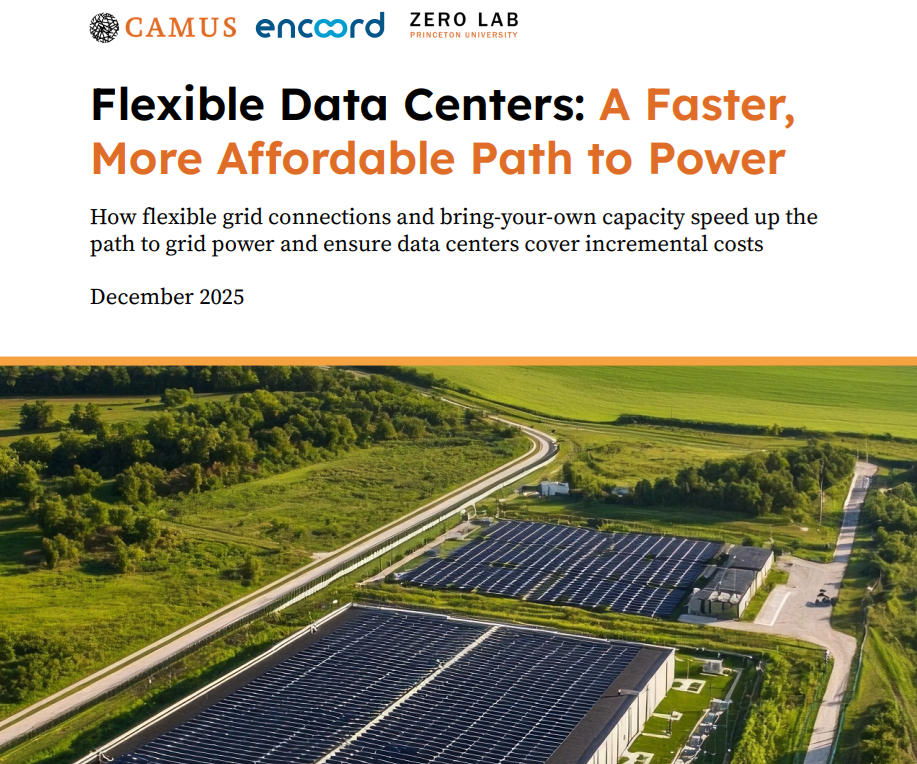
Across the United States, data centers face mounting delays in connecting to the electric grid 1 – with timelines of 3 to 7 years 2 , far longer than the 18-24 month construction timeline for a new data center. This study demonstrates a practical path to accelerate access to grid power. By combining flexible grid connections with bring-your-own capacity (BYOC) arrangements, data centers can reach full operation years sooner while maintaining reliability and improving affordability for all customers.
The challenge
Two bottlenecks dominate the data center interconnection process. Transmission constraints occur when lines cannot carry additional power without upgrades, while generation constraints arise when the system lacks sufficient accredited generation capacity to provide firm service for new load. Both constraints are often binding. In PJM, the most recent capacity auction reached its price cap 3 while transmission upgrades often face multi-year delays. Traditionally, the only remedies are to wait for new infrastructure or shift development to a different location—neither of which meets the speed-to-power needs of today’s AI-driven data center buildout.
The opportunity
Flexible grid connections and BYOC programs provide a two-part solution that directly addresses these bottlenecks. Under a flexible grid connection, a data center receives both firm (uninterruptible) service and conditional firm service 4 , where a portion of the load uses grid power in normal conditions and relies on on-site or co-located resources - including demand-side flexibility - during limited periods of system stress. Through BYOC programs, the data center directly procures the accredited capacity needed to meet firm-service requirements— through clean energy PPAs 5 , VPPs, or on-site resources—rather than waiting years for utility procurement or ISO queue processes.
Together, these mechanisms replace the traditional “build first, connect later” model with a different approach: connect now, operate flexibly during the hours the grid is constrained. This approach aligns the data center’s need for rapid access to power with the utility’s or ISO’s obligations to maintain reliability and ensure affordability. Flexible connections address transmission bottlenecks, while BYOC addresses generation bottlenecks.